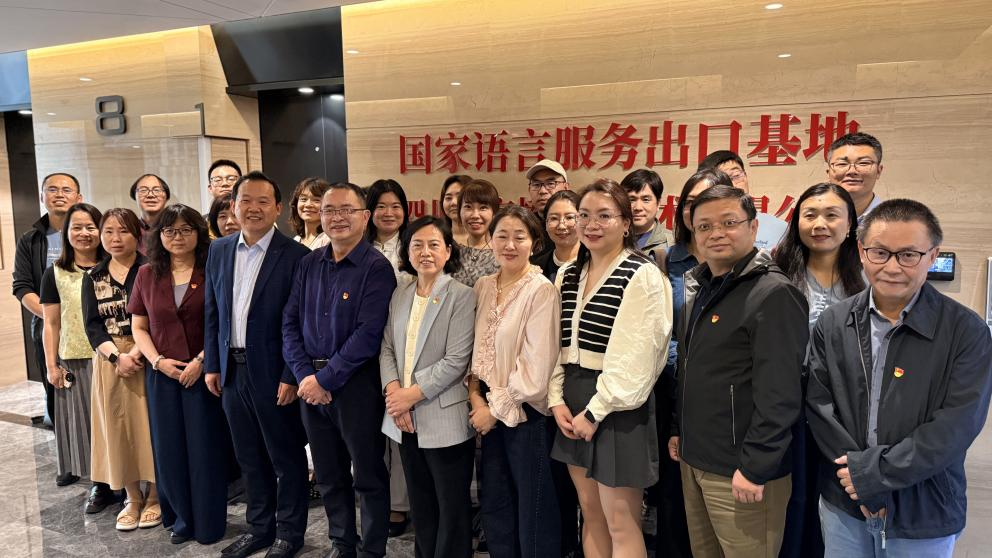
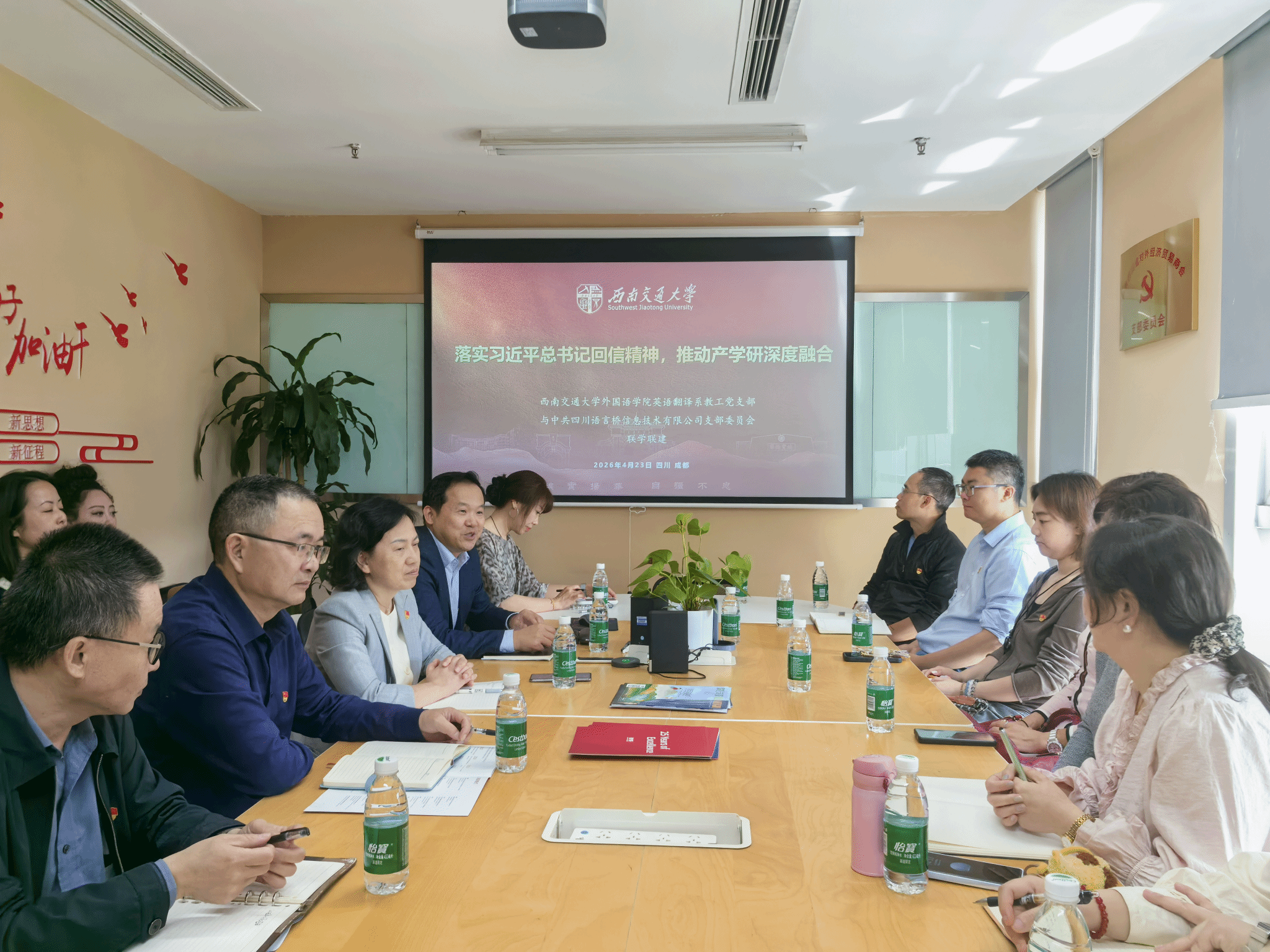
On the afternoon of April 23, all Party members of the Faculty Party Branch of the English Translation Department, School of Foreign Languages visited Sichuan Language Bridge Information Technology Co., Ltd. for a joint learning and Party-building event with the company’s Party Branch. The event aims to thoroughly study and implement the important spirit of General Secretary Xi Jinping’s reply to faculty and students of the four Jiaotong Universities, advance in-depth integration of industry, university and research, and strengthen the independent training of high-caliber translation and English talents.
To begin with, Li Chengjian, Party Secretary of the School of Foreign Languages, introduced the background and significance of the activity. She pointed out that this university-enterprise joint learning and Party-building event coincides with two major milestones: the in-depth study of the spirit of General Secretary Xi Jinping’s important reply and the 130th founding anniversary of the university, making the event of far-reaching significance. General Secretary Xi Jinping’s reply speaks to all faculty and students of Southwest Jiaotong University, including Zhu Xianchao, General Manager of Lan-Bridge and alumnus of the university. In recent years, the joint MTI training program between our School and Lan-Bridge has served as a vital bond for university-enterprise cooperation. Featured the spirit of General Secretary Xi Jinping’s important reply as the red driving force, this event aims to deepen the integration of industry and education, foster talents through joint efforts, and jointly tell Chinese stories well and spread China’s voice to the world. Subsequently, Li Lu, Party Branch Secretary of Lan-Bridge, briefed participants on the company’s Party building work and business development. Founded 26 years ago, Lan-Bridge takes Party building as the guide for business growth. It boats over 1,000 employees covering 150 languages, with multiple branches worldwide. Its business scope encompasses traditional translation, language talent services, and translation technology research and development, focusing on international engineering, biomedicine, cultural globalization and international conferences. She called for deeper cooperation between the university and the enterprise to deliver practical projects and fruitful outcomes, fulfilling the integration of industry, university and research.
During the core session of the activity, Zeng Xiangmin, Secretary of the Faculty Party Branch of the English Translation Department, presided over the First Topic Study. It focused on General Secretary Xi Jinping’s important reply letter, and three Party members from the two branches shared their learning insights. The participants then conducted in-depth discussions on core work of the School, including the Sino-foreign cooperative undergraduate Translation program, joint MTI training program, and the construction of Sichuan Provincial High-Quality Joint Postgraduate Training Bases.
Throughout the session, Song Meihua, Director of the Translation Department, introduced the Sino-foreign cooperative undergraduate Translation program between SWJTU and Oxford Brookes University; Dai Ruoyu, Director of the MTI Center, presented the joint MTI training program run by the School of Foreign Languages and Lan-Bridge; and Zhang Juyan, Director of the English Department, elaborated on the talent training program for the English major. Then, corporate mentors from Lan-Bridge, faculty members of the School, and student representatives participated in the joint training internship at Lan-Bridge put forward suggestions based on industrial practice.
Experts from Lan-Bridge pointed out that there is an urgent demand for interdisciplinary talents with solid linguistic competence, AI proficiency, project management awareness, communication and teamwork skills, as well as professional ethics. They suggested adjusting curriculum design by reducing in-depth programming teaching, strengthening hands-on training of AI tools, adding courses on project management and communication, integrating localization and area studies, and delivering targeted teaching for vertical sectors, such as rail transit, biomedicine and cultural globalization. Faculty members of the School held deep discussions on key topics, including human-machine collaboration in the AI era, differentiated programming courses for liberal arts students, practical teaching via translation workshops, and alignment between area studies and corporate demands, reaching a consensus that students’ core competitiveness lies in solid language foundations, human-machine collaboration capabilities and humanistic literacy. Based on the internship experience across equipment manufacturing, literature, short-video production, finance and other fields, joint-training interns shared AI translation application scenarios and the irreplaceable value of translators, further demonstrating the significance of cultivating interdisciplinary and practice-oriented talents.
Finally, Yu Senlin, Dean of the School of Foreign Languages, concluded the event. He stated that the core essence of this event is the in-depth integration of industry, university and research. Fruitful results have been achieved through university-enterprise cooperation, including the establishment of internship bases, the accreditation of provincial joint postgraduate training bases, and the output of major translation achievements. He also expressed that Lan-Bridge would continue to offer technical and resource support, extend the scope of university-enterprise collaboration from undergraduate and postgraduate programs to doctoral training, and deepen cooperation focusing on the research, development and application of AI translation technology. Besides, He called for continuous optimization of joint training programs and expansion of cooperation channels covering undergraduate internships, staff exchanges and practical projects, so as to make university-enterprise cooperation more effective and high-quality. Both sides will jointly advance the high-quality development of translation studies and the iterative upgrading of foreign language talent cultivation.
This joint learning and Party-building event is a concrete practice of the School of Foreign Languages, which thoroughly implements the spirit of General Secretary Xi Jinping’s important reply and advance in-depth integration of industry, university and research. The university and the enterprise will make joint efforts to take Party building as the guide, talent cultivation as the fundamental mission, and industrial demands as the orientation. They will transform the spirit of the important reply into driving forces for talent education and practical cooperation outcomes, further advancing the collaboration among talent training, practical teaching, technological innovation and social services.