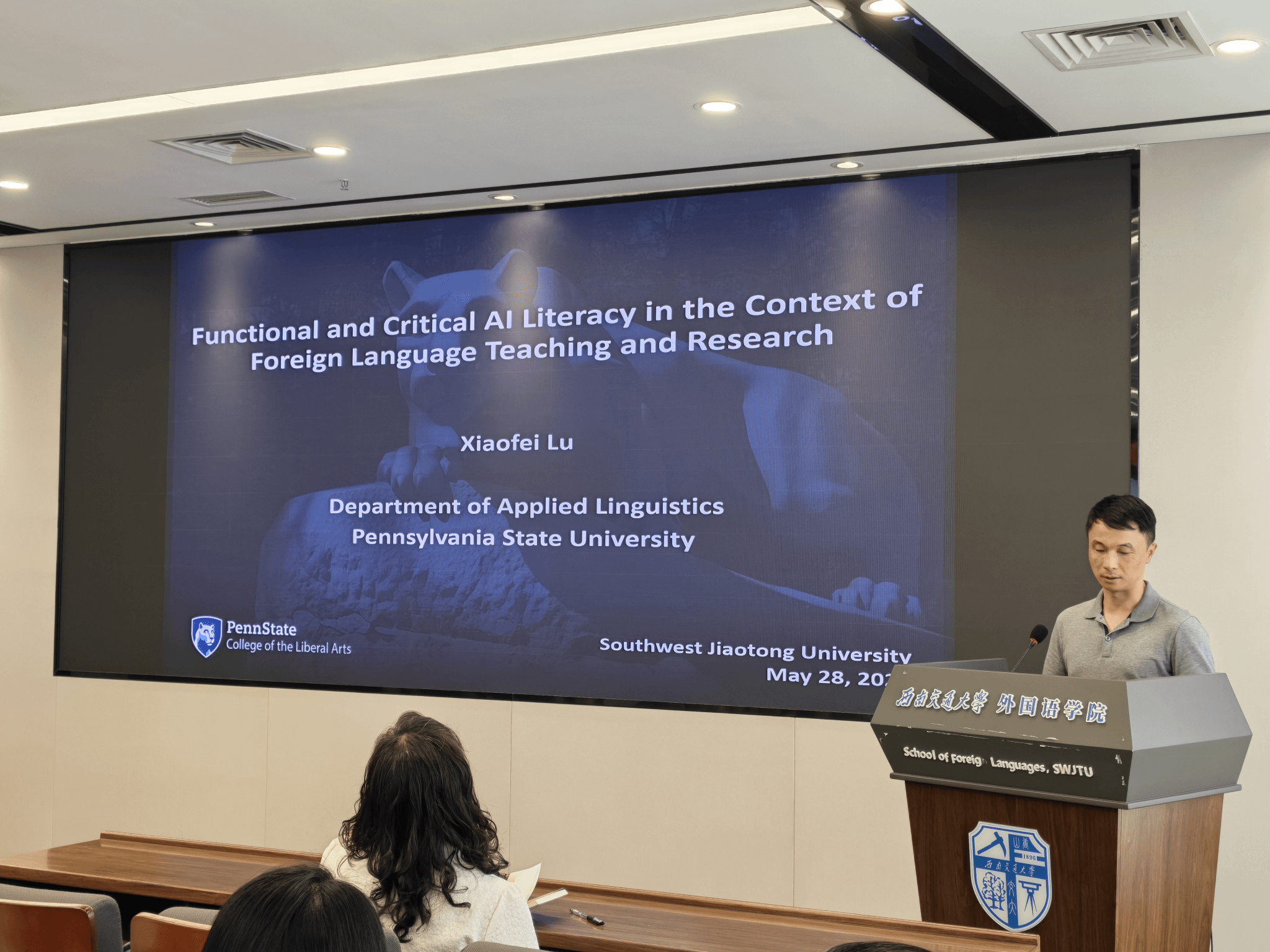
The School of Foreign Languages at SWJTU hosted the 9th Innovation Lecture Series of 2026 at 4 p.m. on May 28 in Room X30820, Xipu Campus. The lecture, themed Functional & Critical AI Literacy for Foreign Language Teaching and Research, featured Professor Lu Xiaofei, doctoral supervisor at Pennsylvania State University, as its keynote speaker. Entrusted by the School, Associate Professor Luo Zaibing, Head of the Linguistics Discipline Team, presided over the lecture, while Professor Xu Xiaoyan gave an introduction to the guest speaker. Faculty and students in linguistics, translation studies and MTI at the university actively attended the lecture.
Focusing on AI literacy in foreign language teaching and research amid the rapid advancement of AI, Professor Lu systematically explored the connotation, application, development and assessment of functional and critical AI literacy. To begin with, he defined the core concepts of functional and critical AI literacy and outlined their key components. Functional AI literacy mainly covers an understanding of the principles of large language models as well as their prediction, reasoning and generation mechanisms. By contrast, critical AI literacy refers to users’ ability to critically evaluate outputs produced by AI prediction, reasoning and generation. He also pointed out that users should neither fully trust that AI outputs outperform human work in terms of specific contexts, scenarios and personalized tasks, nor worry that humans will be replaced by AI.
On this basis, the lecture further analyzed the interactive relationship and complementary functions of functional and critical AI literacy amid foreign language teaching and research. With foreign language teaching practices and relevant research findings, it focused on the application potential and practical challenges of AI in diverse dimensions, including learning support, language assessment, feedback generation, the development of learner autonomy, and research data analysis. The presentation also explored approaches to cultivating and evaluating functional and critical AI literacy for foreign language educators, researchers and learners. Professor Lu finally proposed potential development of future research on AI literacy within foreign language teaching and research, aiming to deliver practical insights for the effective integration of AI into foreign language education. During the Q&A session, he engaged in in-depth, comprehensive and detailed exchanges with faculty and students present. The two-hour lecture was rich in content, logically coherent and broad in vision. It combined solid theoretical foundations with close attention to disciplinary frontiers, offering all attendees a high level, cutting-edge academic experience.