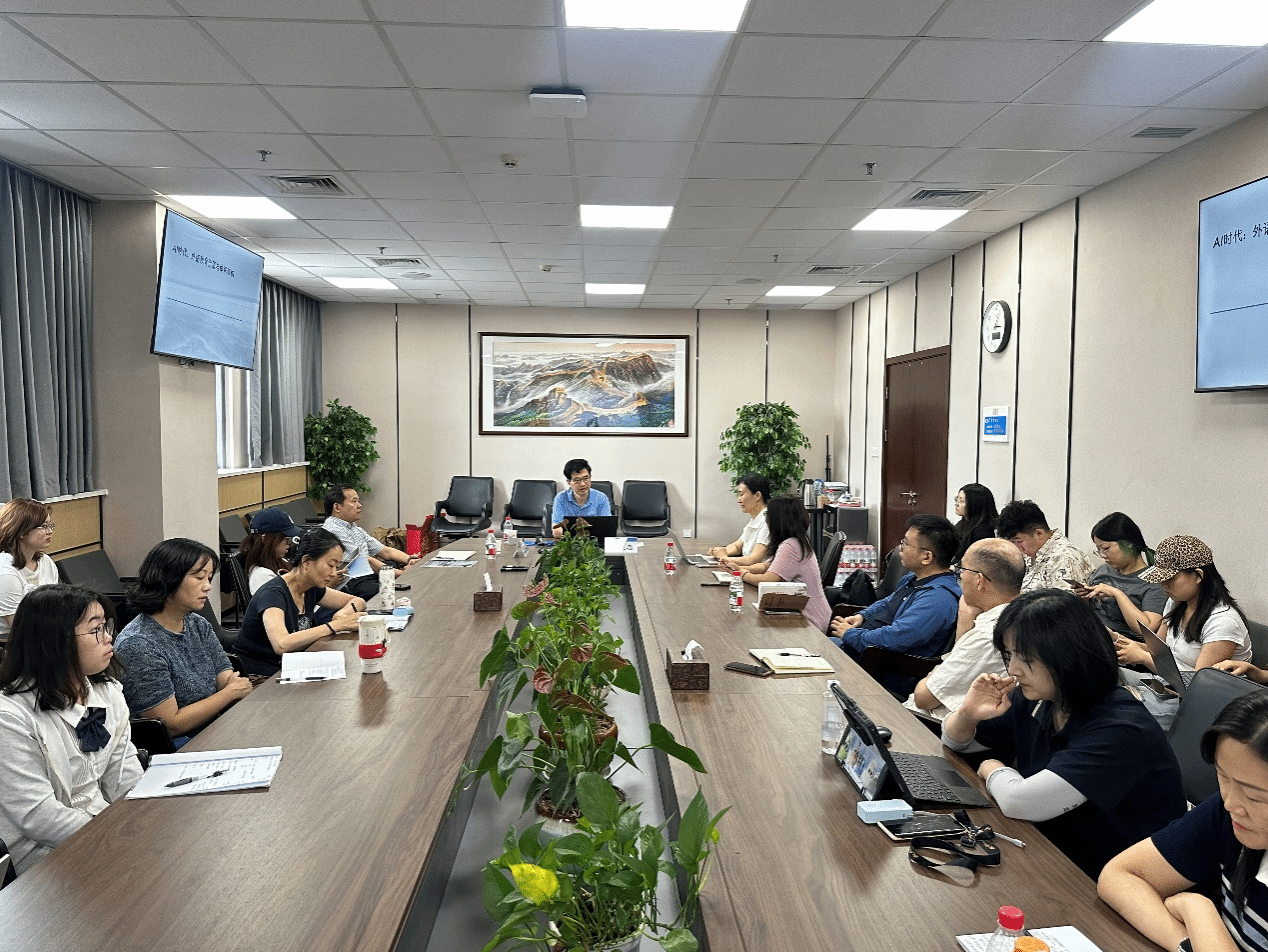
At the invitation of the School of Foreign Languages, Professor Chu Chengzhi from the University of California, Davis delivered a special academic lecture on the afternoon of June 10, 2026, in Room 30824, Building 3, on Xipu Campus. With the aim of broadening international horizons of faculty and students, the lecture explored innovative paths for foreign language education amid artificial intelligence, and boosted the disciplinary development of international Chinese language education and foreign language teaching. It was presided over by Professor Zeng Xiangmin, Teaching Director of the School. Faculty and students in fields covering international Chinese language education, foreign language education attended the lecture and engaged in interactive discussions afterwards.
The lecture, titled Ecology, Geopolitics, AI and Policy: Chinese and Other Foreign Language Education amid America’s Sociolinguistic Ecology, focused on trending and challenging issues in contemporary foreign language education. At the opening of the lecture, Professor Chu adopted a global perspective to systematically outline overall language policies and the distribution of linguistic resources in the United States. He also conducted an in-depth analysis of the current development and practical difficulties of local Chinese language education. Combining multiple factors including geopolitical settings and social culture, he interpreted the evolution of foreign language education in diverse contexts. On the core theme of profound transformations brought to conventional foreign language education by the rapid advancement of artificial intelligence, Professor Chu then delivered key expositions, objectively analyzing the impacts and challenges AI technology poses to foreign language teaching models, instructional content, as well as the roles of faculty and students. With decades of overseas teaching and research experience, he proposed targeted solutions, pointing out that foreign language education in the new era must take the initiative to restructure the core values of the discipline.
The interactive Q&A session was lively and engaging. Based on practical problems encountered in their academic studies and teaching practices, faculty and students present raised questions enthusiastically, covering the certification system for Chinese language teachers in the United States, standardized application of AI teaching tools in foreign language classrooms, and the development of smart courses. Professor Chu provided detailed responses to all questions and shared unique insights grounded in cutting-edge research findings. He encouraged all faculty and students to stay focused on the latest advances in international foreign language education, boldly explore new models and methods for foreign language teaching in the AI era, and take proactive strides amid the evolving landscape of disciplinary development.
The lecture featured profound theoretical perspectives, global visions and practical guiding. It not only illustrated the evolution of language education in the United States, but also identified the future development of AI-empowered foreign language education. All participants stated that they had greatly benefited from the session, which brought new ideas to their academic research and teaching practice.